





Strabismus, commonly known as "crossed eyes," "squint," or "eye turn," occurs when the two eyes do not point in the same direction at the same time. One eye may look straight ahead while the other turns inward, outward, upward, or downward. It is a common condition, affecting an estimated 2% to 4% of children, and it can also develop for the first time in adulthood. If left untreated during early childhood, strabismus can lead to permanent vision loss in one eye (amblyopia). In adults, a sudden new eye turn can sometimes signal an underlying neurological or systemic condition and warrants prompt evaluation.
This guide explains what causes strabismus, how it differs between children and adults, how it's diagnosed, and which treatments are available today.
What is strabismus?
Strabismus is a misalignment of the eyes caused by a lack of coordination between the extraocular muscles, the six small muscles attached to each eye that control its movement. For binocular vision to work properly, both eyes must move together and point at the same object simultaneously, allowing the brain to fuse two slightly different images into one three dimensional picture. When one eye deviates, the brain receives two mismatched images and must compensate, often by suppressing (ignoring) the input from the misaligned eye.
Strabismus is classified by the direction of deviation:
- Esotropia: one eye turns inward, toward the nose.
- Exotropia: one eye turns outward, away from the nose. This is the deviation most people picture when they think of an eye "drifting."
- Hypertropia: one eye turns upward.
- Hypotropia: one eye turns downward.
It is also described by how often it occurs and how it behaves:
- Constant vs. intermittent: present all the time, or only under certain conditions such as fatigue, illness, bright light, or close up reading.
- Unilateral vs. alternating: always the same eye deviates, or the two eyes take turns.
- Comitant vs. incomitant: the size of the deviation stays the same in every direction of gaze (comitant, typical of childhood strabismus), or it changes depending on gaze direction (incomitant, which often points to a specific muscle or nerve problem and is more typical of adult onset cases).
Strabismus in children
Population based studies estimate that strabismus affects roughly 2% to 4% of children, although prevalence varies by age, population, ethnicity, and study methods. Esotropia and exotropia account for most cases, but their relative frequency varies considerably across populations. Many cases are detected during infancy or the preschool years, before school age.
Why early detection matters
During the first years of life, the visual system is still developing and remains highly adaptable, a period ophthalmologists call the "critical period" of visual development, which extends roughly through age 7 to 9, with the greatest sensitivity before age 5 to 6. If one eye is misaligned during this window, the brain may learn to ignore the images from that eye to avoid double vision. Over time, this can lead to amblyopia, which becomes progressively harder to reverse the longer it goes untreated.
Common causes and risk factors in children
- Uncorrected refractive errors: Significant hyperopia (farsightedness) is a well recognized trigger for esotropia because the extra focusing effort required to see clearly is linked to convergence, or inward eye movement. Myopia and astigmatism are also associated with strabismus, particularly exotropia.
- Family history: Children with a parent or sibling who had strabismus have a meaningfully higher likelihood of developing it themselves.
- Prematurity and low birth weight: Both are associated with an increased risk of strabismus.
- Developmental and neurological conditions: Conditions such as cerebral palsy and certain genetic syndromes are associated with higher rates of strabismus.
When is eye drifting normal in infants?
Some degree of intermittent eye drift during the first few months of life can be a normal part of visual maturation. A deviation that persists beyond about 4 to 6 months of age, or that is constant at any age, should be assessed by an eye care professional.
Why parents may not notice strabismus
Because young children have no reference point for "normal" vision, they rarely complain of blurry or double vision, even when one eye is significantly weaker. This is why routine pediatric vision screening, rather than waiting for a child to report symptoms, is important for detecting strabismus and amblyopia early.
Strabismus in adults
Adult strabismus can be broadly divided into two categories: strabismus that began in childhood and persists or becomes decompensated, and strabismus that develops for the first time in adulthood. Because newly acquired strabismus can sometimes indicate an underlying neurological, vascular, thyroid, or neuromuscular condition, identifying when the misalignment began is an important part of the evaluation.
Decompensated childhood strabismus
Some adults have a small, well controlled eye misalignment, sometimes called a phoria, that causes few or no symptoms for years because the brain's fusion mechanisms compensate for it. Fatigue, illness, stress, alcohol, or simply aging can reduce this compensatory capacity, allowing a previously controlled deviation to become more noticeable or symptomatic. This is known as decompensated strabismus.
Acquired strabismus
When strabismus develops for the first time in adulthood, possible causes include:
- Cranial nerve palsies: Problems affecting the third, fourth, or sixth cranial nerves can disrupt eye movement. Causes include microvascular disease, particularly in people with diabetes or high blood pressure, as well as aneurysms, tumors, and trauma.
- Thyroid eye disease: Associated with Graves' disease, inflammation and swelling of the eye muscles can restrict normal eye movement. It is an important cause of acquired strabismus in adults.
- Stroke and other central nervous system disorders: Damage to the brain or brainstem areas responsible for coordinating eye movements can result in strabismus and double vision.
- Myasthenia gravis: This neuromuscular disorder can cause fluctuating double vision and eyelid drooping that may mimic or contribute to strabismus.
- Orbital trauma or fractures: Injury around the eye can mechanically restrict the movement of one or more eye muscles.
- Complications after eye surgery: Cataract, retinal, or other eye surgery can rarely result in new or recurrent eye misalignment.
- Loss of vision in one eye: Severe vision loss from conditions such as cataracts, macular degeneration, or eye injury can disrupt the visual input that helps maintain alignment. This can lead to sensory exotropia, in which the affected eye gradually drifts outward.
Symptoms and signs
Symptoms and signs vary by age and cause, but commonly include:
- A visible misalignment of the eyes, which may be constant or come and go.
- Double vision (diplopia), which is much more common in adults. Children's brains typically suppress the second image rather than consciously perceiving it.
- Eye strain, headaches, or fatigue, especially when reading or using screens.
- Squinting or closing one eye in bright sunlight.
- Tilting or turning the head to a particular position to maintain single vision.
- Reduced depth perception.
- In children specifically, there may be few or no complaints despite an obvious eye misalignment because they have no comparison point.
Diagnosis and ophthalmological examination
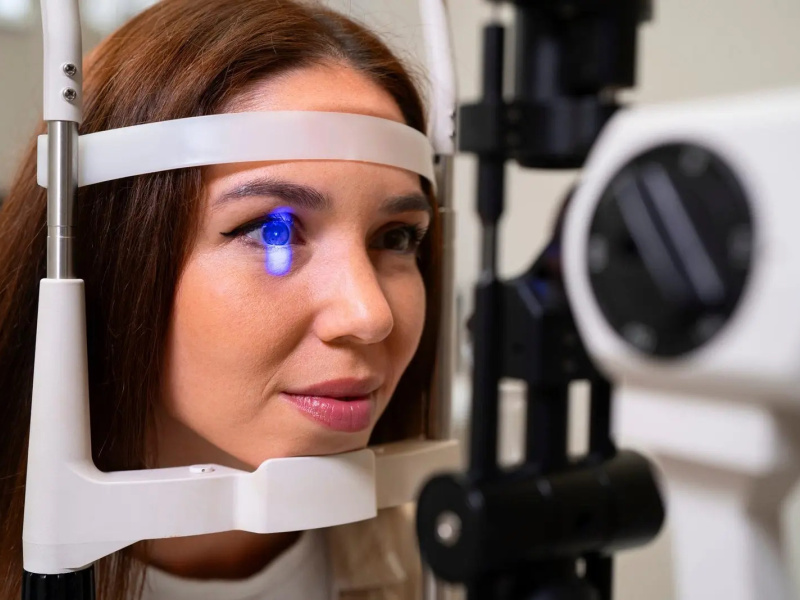
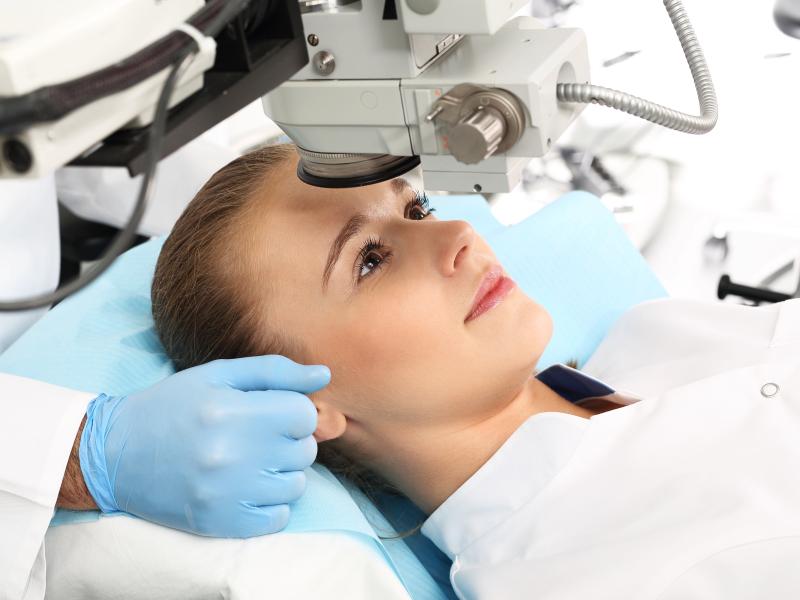
Diagnosing strabismus accurately requires a comprehensive eye examination, which typically includes:
- Case history: onset, whether the misalignment is constant or intermittent, family history, and any associated neurological or systemic symptoms.
- Visual acuity testing: each eye is tested separately.
- Cover test and cover uncover test: the examiner covers and uncovers each eye while the patient focuses on a target. This helps determine the direction and, with prism lenses, the magnitude of the eye deviation, measured in prism diopters.
- Assessment of eye movements: movements are evaluated in all directions of gaze to determine whether a specific eye muscle or cranial nerve may be involved.
- Refraction: this identifies uncorrected hyperopia, myopia, or astigmatism.
- Stereopsis and binocular function testing: these tests assess depth perception and the ability of the eyes to work together and maintain single vision.
- Dilated fundus examination: this may be performed to rule out other eye conditions that could contribute to or mimic strabismus.
- Neuroimaging: MRI or CT may be recommended when a sudden onset or incomitant deviation raises suspicion of an underlying neurological cause, particularly in adults.
Strabismus and amblyopia (lazy eye) in children
Amblyopia is reduced vision in one eye that is not correctable simply by wearing glasses, caused by the brain favoring the stronger eye during early visual development. Strabismus is one of the leading causes of amblyopia in children, alongside uncorrected refractive errors.
Because the visual system is most adaptable in the first several years of life, amblyopia treatment is most effective when started early, ideally before age 6 to 8. Standard approaches include:
- Correcting the underlying refractive error with glasses, which alone can resolve mild amblyopia in some children.
- Patching therapy, temporarily covering the stronger eye to force the brain to use and strengthen the weaker eye.
- Atropine eye drops in the stronger eye as an alternative to patching in some cases, used to blur that eye's near vision.
- Addressing the strabismus itself, through glasses, prisms, or surgery, as part of the overall treatment plan.
Regular pediatric vision screening remains the most effective way to catch amblyopia while it is still treatable, since children rarely report the problem themselves.
Available treatment options
Treatment is individualized based on the type and cause of strabismus, the patient's age, and the functional or cosmetic impact. Most ophthalmologists start with the least invasive option that is appropriate and escalate only if needed.
Glasses and refractive correction
When strabismus is linked to uncorrected hyperopia, myopia, or astigmatism, properly prescribed glasses (or, in some adults, contact lenses) are the first step. In some children with accommodative esotropia, glasses alone can fully or substantially correct the eye alignment.
Prism glasses
Prism lenses bend incoming light to compensate for the eye's deviation, which can reduce double vision and eye strain without surgery. They are most useful for smaller, stable deviations. Prisms can be used temporarily (as a clip-on "Fresnel" prism) to see whether they help before committing to a permanent lens, or as a longer-term management option, particularly in adults who are not surgical candidates or who prefer to avoid surgery.
Orthoptic and vision therapy
Structured eye-muscle and binocular vision exercises, guided by an orthoptist, can help in specific situations, notably some forms of intermittent exotropia, convergence insufficiency, and post-surgical fine-tuning of binocular function. Evidence supports vision therapy for well-selected conditions such as convergence insufficiency; it is not a substitute for surgery or optical correction in cases of significant constant misalignment, and its role should be discussed with an ophthalmologist or orthoptist based on the specific diagnosis.
Strabismus surgery
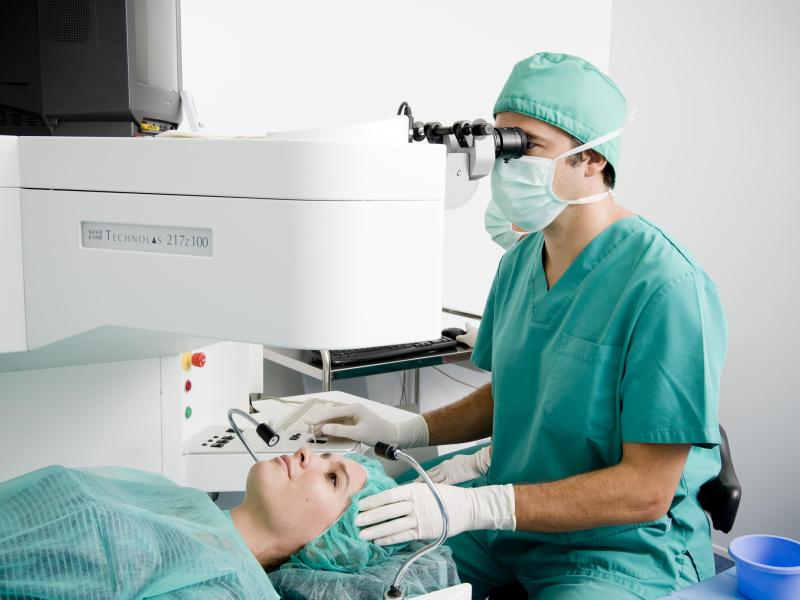
Surgery adjusts the length or position of one or more extraocular muscles to rebalance eye alignment. The two basic techniques are:
- Recession: moving a muscle's attachment point further back on the eye to weaken its pull.
- Resection: shortening a muscle to strengthen its pull.
Most procedures combine these techniques across one or both eyes, tailored to the specific pattern of misalignment. Surgery is typically performed under general anesthesia in children and can be done under local or general anesthesia in adults.
When to consult an ophthalmologist
- For children: any eye deviation that persists beyond 4 to 6 months of age, or that is present at any age in a constant form, should be evaluated. Waiting for a child to "grow out of it" is not recommended, since most childhood strabismus needs active management to protect vision. A family history of strabismus, amblyopia, or high refractive error is an additional reason to schedule an early screening.
- For adults: schedule an evaluation for any new eye misalignment, especially if it appeared gradually, or if you're managing an existing childhood strabismus that has changed.
Warning signs requiring urgent evaluation in adults
Seek prompt medical attention, the same day if possible, for sudden onset strabismus accompanied by any of the following, as these can indicate a neurological or vascular emergency:
- Sudden double vision, especially if it appeared over hours or a few days.
- Drooping eyelid, especially on one side.
- Severe headache, described as "the worst of your life," or a headache unlike previous ones.
- Facial numbness, weakness, or asymmetry.
- Difficulty speaking, confusion, or difficulty walking.
- Pain with eye movement or bulging of one eye.
These combinations can signal conditions such as stroke, aneurysm, or increased pressure in the brain, and should not wait for a routine ophthalmology appointment, seek emergency care.

"Medical journalist specializing in science communication, I put my expertise at the service of clear and accessible information. For Turquie Santé, I create content based on up-to-date medical data, in collaboration with specialists from partner clinics. My commitment is to provide reliable, transparent information that complies with international medical standards."
Need a personalized medical opinion?
Our partner doctors reply online within 24h, free of charge.