





Summary
- What causes an abdominal aortic aneurysm?
- Symptoms and warning signs
- How is an abdominal aortic aneurysm diagnosed?
- Elective vs. emergency treatment: Why the distinction matters
- Treatment options for abdominal aortic aneurysm
- Emergency treatment for a ruptured aneurysm
- Post-operative follow-up and long-term monitoring
- Prevention of Abdominal Aortic Aneurysm
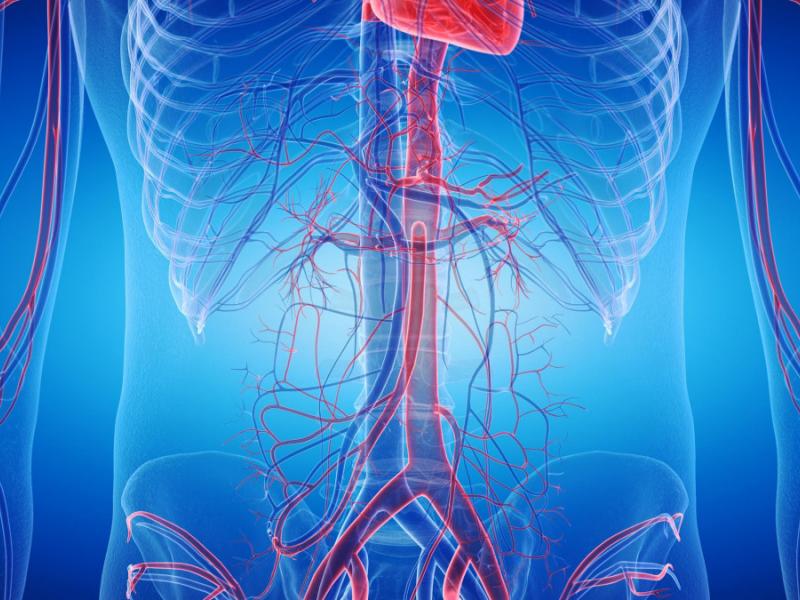
The aorta is the body’s largest artery, carrying blood from the heart to the rest of the body. When a weakened area of the abdominal aorta expands to 3 cm or more, it is called an abdominal aortic aneurysm (AAA).
Most AAAs cause no symptoms and are often discovered during routine or unrelated imaging. However, as the aneurysm grows, the risk of rupture increases, potentially causing life-threatening internal bleeding.
The good news is that many AAAs can be detected and monitored before they become dangerous. Depending on their size and growth, treatment may involve regular monitoring, endovascular aneurysm repair (EVAR), or open surgery. Understanding the symptoms, diagnosis, treatment options, and risk factors can help patients make informed decisions with their doctor.
What causes an abdominal aortic aneurysm?
An abdominal aortic aneurysm (AAA) usually develops through a combination of genetic, biological, and cardiovascular risk factors rather than a single cause. These factors can weaken the structure of the aortic wall and promote progressive enlargement of the artery.
Smoking
Smoking is one of the strongest modifiable risk factors for AAA and is associated with both a higher risk of developing an aneurysm and faster aneurysm growth. Former smokers remain at elevated risk for years after quitting, though the risk declines over time.
Hypertension (high blood pressure)
High blood pressure places ongoing mechanical stress on the arterial wall and is associated with an increased risk of AAA and aneurysm rupture. Controlling blood pressure is an important part of cardiovascular risk management in people with an AAA.
Atherosclerosis and cardiovascular disease
AAA shares several risk factors with atherosclerotic cardiovascular disease, including smoking, high blood pressure, and older age. However, an AAA is not simply caused by a buildup of fatty plaques. Inflammation, changes in the extracellular matrix, and weakening of the aortic wall also play important roles in its development.
Advancing age and male sex
Advanced age and male sex are well-established risk factors for abdominal aortic aneurysm (AAA). The condition is more common in men, particularly among older adults. Women are affected less often, but when an aneurysm is present, they may have a higher risk of rupture at a smaller diameter than men. Sex is therefore considered when assessing risk and choosing the most appropriate treatment.
Family history
A family history of AAA increases the likelihood of developing the condition. First-degree relatives, such as parents or siblings, may therefore be considered for screening depending on their age and individual risk factors.
Connective tissue disorders
Some inherited conditions can increase the risk of aortic aneurysms, including Marfan syndrome, Loeys-Dietz syndrome, and vascular Ehlers-Danlos syndrome. These disorders can affect the structural components of the arterial wall and may lead to aortic disease at a younger age.
People with suspected hereditary aortic disease require individualized assessment and may need different surveillance and treatment strategies from those used for typical degenerative AAAs.
Other risk factors
Other conditions associated with AAA include coronary artery disease, peripheral artery disease, chronic obstructive pulmonary disease, and certain genetic factors. Interestingly, diabetes has been associated with a lower risk of AAA in several studies, although the relationship is complex and not fully understood.
In most patients, AAA develops from a combination of risk factors rather than one identifiable cause. Understanding these factors can help doctors assess individual risk and determine whether screening, monitoring, or preventive measures are appropriate.
Symptoms and warning signs
Unruptured AAA. The great majority of aneurysms produce no symptoms at all while they are intact, regardless of size. Some patients report vague abdominal or back discomfort, or notice a pulsating sensation near the navel, but this is the exception rather than the rule. This absence of warning signs is exactly why incidental discovery and targeted screening play such a central role in management.
Signs that require emergency care. A few symptoms should never be dismissed in a patient with a known or suspected aneurysm:
- Sudden, severe abdominal or back pain
- A tender, pulsating mass in the abdomen
- Lightheadedness, fainting, or a rapid drop in blood pressure
- Signs of shock (cold, clammy skin; rapid heartbeat; confusion)
This combination of symptoms can indicate that the aneurysm wall is tearing (a contained or "sentinel" leak) or has already ruptured. Both situations are medical emergencies that require immediate transport to a hospital capable of emergency vascular surgery.
How is an abdominal aortic aneurysm diagnosed?
Because AAA gives no warning, screening is the main way to catch it early. The U.S. Preventive Services Task Force (USPSTF, 2019) recommends:
| Group | Recommendation |
| Men 65–75 who have ever smoked | One-time ultrasound screening (Grade B) |
| Men 65–75 who never smoked | Offered case-by-case (Grade C) |
| Women, never smoked, no family history | Routine screening not recommended (Grade D) |
| Women 65–75, smoker or family history | Decided individually with a physician |
The test itself is a simple abdominal ultrasound. It is painless, does not use radiation, and usually takes about 10 to 15 minutes.
Monitoring an existing aneurysm
When an aneurysm is identified, its maximum diameter determines how closely it needs to be watched. The 2018 clinical practice guidelines of the Society for Vascular Surgery (SVS) set out the following surveillance intervals for asymptomatic, non-operative aneurysms:
| Aortic diameter | Recommended surveillance |
| 3.0 – 3.9 cm | Ultrasound every 2–3 years |
| 4.0 – 4.9 cm | Ultrasound every 12 months |
| 5.0 – 5.4 cm | Ultrasound or CT every 6 months |
| ≥ 5.5 cm (or rapid growth) | Referral for elective repair |
Growth rate matters as much as absolute size. An aneurysm expanding by more than 1 cm per year, or more than 0.5 cm over six months, is considered rapidly growing and warrants a discussion about repair even if the diameter has not yet reached the standard threshold, since rapid growth is itself an independent predictor of rupture.
Before surgery
If repair is being considered, a work-up typically includes a CT angiogram (to map the aneurysm's exact size and shape), heart and lung tests to check fitness for surgery, and a check for aneurysms elsewhere, especially in the iliac arteries.
Elective vs. emergency treatment: Why the distinction matters
Treatment for AAA falls into two fundamentally different categories, and confusing them can be misleading for patients trying to understand their own situation.
- Elective treatment is planned in advance, on a stable patient. It's the safer path by far: mortality is generally under 5% for open surgery and under 2% for EVAR at experienced centers.
- Emergency treatment is needed after a rupture, performed under extreme time pressure on a patient often in shock. Reported mortality ranges from roughly 65% to over 80% once rupture occurs, including deaths before reaching a hospital.
This contrast is the single most important argument for early detection: an aneurysm caught at 4 cm and monitored is an entirely different clinical problem from the same aneurysm discovered after it has torn.
Treatment options for abdominal aortic aneurysm
The choice of treatment depends on aneurysm size and growth rate, the patient's anatomy, overall cardiovascular and pulmonary fitness, and personal preference. A vascular surgeon weighs all of these factors before recommending a course of action; there is no single "correct" answer that applies to every patient.
Surveillance and medical management
For aneurysms below the repair threshold, the initial approach is not surgical. It is a structured program combining:
- Scheduled imaging at the intervals outlined above
- Strict blood pressure control, generally targeting standard cardiovascular goals as advised by the treating physician
- Complete smoking cessation, which has been shown to slow aneurysm growth
- Management of cholesterol and, where present, diabetes
- Regular, moderate physical activity, as tolerated
This slows aneurysm growth and lowers overall cardiovascular risk, delaying or avoiding surgery the patient doesn't yet need. No medication has been proven to shrink an aneurysm or reliably halt its growth, statins help cardiovascular risk generally, but haven't shown a specific effect on aneurysm expansion.
Open surgical repair
- When it's used: typically once a fusiform aneurysm reaches 5.5 cm in men (around 5.0 cm in women, per some guidelines, given their higher rupture risk at smaller sizes⁵), for saccular aneurysms of any size, for rapid growth, or when anatomy isn't suitable for a stent graft.
- The procedure: under general anesthesia, the surgeon opens the abdomen, removes the damaged segment of aorta, and sews in a synthetic graft to replace it, extending into the iliac arteries if needed.
- Recovery: hospital stay of about 5–10 days, including time in intensive care; full recovery generally takes 6–12 weeks.
- Risks: as with any major abdominal surgery, bleeding, infection, cardiac or respiratory complications, and less commonly bowel or graft-related issues. Elective mortality is generally cited at 1–5%, depending on age, health, and hospital experience.
- Why it's still used: decades of long-term data, a low rate of late problems, and it remains the go-to option when anatomy rules out a stent graft.
Endovascular aneurysm repair (EVAR)
- When it's used: EVAR depends on anatomy, mainly having a suitable "neck" of healthy aorta below the kidneys and iliac arteries wide enough for the delivery system. Not every patient qualifies.
- The procedure: through small incisions in the groin, the surgeon threads a folded stent graft up to the aneurysm under X-ray guidance and expands it in place, sealing the weakened section off from blood pressure.
- Recovery: much shorter, typically 1–3 days in hospital and back to normal activity within 2–4 weeks.
- Main risk, endoleak: blood can still leak into the aneurysm sac around the graft. Type I (at the attachment points) and Type III (a defect in the graft) need prompt treatment, since the sac stays under full pressure. Type II (backflow from small side branches) is more common and is usually just monitored unless the sac keeps growing.
- Follow-up: because problems can develop silently, EVAR requires lifelong imaging, typically a scan at 1 month, then yearly.
EVAR vs. Open Repair: What the evidence shows
Randomized trials comparing the two techniques (EVAR-1, DREAM, OVER, and ACE) show a consistent pattern that is important for patients to understand realistically:
- Short term (30 days to 6 months): EVAR carries a clear survival advantage, with roughly half the perioperative mortality of open repair.
- Medium term (2–8 years): The survival curves of the two groups converge; the early advantage of EVAR essentially disappears.
- Longer term (beyond 3 years): Aneurysm-related mortality and the need for secondary procedures (to address endoleak, migration, or graft-related problems) become more frequent in the EVAR group than in the open-repair group.
In short, EVAR is easier on the body in the short term, while open repair tends to be more durable in the long term for patients fit enough to tolerate it. Neither option is categorically “better.” The right choice is individualized, taking into account age, life expectancy, anatomy, and the patient’s priorities regarding recovery time and long term durability.
Emergency treatment for a ruptured aneurysm
A ruptured or actively leaking AAA is a surgical emergency, treated as fast as possible, ideally within the first hour. When anatomy allows it, emergency EVAR is generally preferred, since it carries lower short-term mortality in this setting; open repair remains necessary when anatomy or the patient's condition doesn't allow time for an endovascular approach. Outcomes depend heavily on how fast the patient reaches a hospital equipped for emergency vascular surgery, which is why sudden severe abdominal or back pain in anyone with a known aneurysm calls for an immediate ambulance.
Post-operative follow-up and long-term monitoring
Recovery does not end at hospital discharge. Regardless of the technique used, long-term follow-up is part of the treatment itself:
- After EVAR: contrast-enhanced CT or duplex ultrasound at one month, then at regular intervals (commonly annually) for life, to detect endoleak, sac enlargement, or device migration before they cause problems.
- After open repair: clinical follow-up with periodic imaging (commonly every five years, or sooner if symptoms arise) to check for graft-related complications or the late development of a pseudoaneurysm at the graft's attachment sites.
- For both: ongoing management of the underlying cardiovascular risk factors, blood pressure, smoking cessation, cholesterol, and physical activity, since the same disease process that caused the original aneurysm can affect other arterial segments over time.
Patients are also advised to avoid heavy lifting and strenuous exertion for the initial weeks after surgery and to report any new abdominal pulsation, pain, fever, or wound changes promptly.
Prevention of Abdominal Aortic Aneurysm
Some risk factors, such as age, sex, and family history, cannot be changed. Others can be actively managed, and doing so measurably reduces both the likelihood of developing an aneurysm and its rate of growth if one is already present:
- Stop smoking. This is the single most impactful modifiable step, affecting both the risk of developing an aneurysm and how fast an existing one grows.
- Control blood pressure and cholesterol, ideally with regular medical follow-up rather than self-management.
- Manage diabetes if present, as part of overall cardiovascular risk reduction.
- Stay physically active, within levels appropriate to overall health.
- Get screened if eligible. A one-time ultrasound is recommended for men aged 65–75 who have ever smoked, and should be discussed individually with a physician by other at-risk groups, including those with a first-degree relative who has had an AAA.
An aneurysm found at 3.5 cm can be followed safely for years, often treated electively under ideal conditions. One found only after rupture offers no such margin, which is exactly why early detection matters so much.
This article is for general information only and doesn't replace an individual consultation with a vascular surgeon or cardiologist. Decisions about surveillance or treatment should be made with a qualified physician based on personal history and imaging.

"Medical journalist specializing in science communication, I put my expertise at the service of clear and accessible information. For Turquie Santé, I create content based on up-to-date medical data, in collaboration with specialists from partner clinics. My commitment is to provide reliable, transparent information that complies with international medical standards."
Need a personalized medical opinion?
Our partner doctors reply online within 24h, free of charge.


"An eminent Professor of cardiovascular surgery, Dr. Necmettin Çolak leads cutting-edge cardiac interventions in Ankara. Specialized in vascular pathologies and open-heart surgeries, he ensures our heart health articles reflect the latest clinical guidelines. His validation provides peace of mind for our readers."
Sources & references
- U.S. Preventive Services Task Force. Screening for Abdominal Aortic Aneurysm: Recommendation Statement. JAMA, 2019.
- Centers for Disease Control and Prevention. About Aortic Aneurysm.
- Deery S.E., et al. Sex differences in mortality and morbidity following repair of intact abdominal aortic aneurysms. Journal of Vascular Surgery, 2017;65(4):1006–1013.
- U.S. Preventive Services Task Force. Final Recommendation Statement: Abdominal Aortic Aneurysm: Screening. December 10, 2019.
- Chaikof E.L., et al. The Society for Vascular Surgery practice guidelines on the care of patients with an abdominal aortic aneurysm. Journal of Vascular Surgery, 2018;67(1):2–77.e2.
- Society for Vascular Surgery. Guidelines Summary: Abdominal Aortic Aneurysm.
- National Institute for Health and Care Excellence (NICE). Abdominal aortic aneurysm: diagnosis and management. NICE Guideline NG156, 2020.
- Powell J.T., et al. Meta-analysis of individual-patient data from EVAR-1, DREAM, OVER and ACE trials comparing outcomes of endovascular or open repair for abdominal aortic aneurysm over 5 years. British Journal of Surgery, 2017;104(3):166–178.
- American Heart Association. Aortic Aneurysm.


Among our clinics