







Summary
- What is tuberous breast deformity?
- What does a tuberous breast look like?
- Grolleau classification, the reference system
- Who is a candidate for surgery?
- Surgical techniques used in Turkey
- How does the operation proceed?
- Tuberous breast correction prices: Turkey vs. the world
- Postoperative recovery
- Risks and complications
- Frequently asked questions
Tuberous breast deformity is a congenital condition affecting breast development during puberty. While often under-diagnosed, it is among the most complex cases in cosmetic breast surgery. Turkey, and Istanbul in particular, has become a leading destination for its correction, combining specialized expertise with prices significantly lower than in Western Europe or the United States. This article details the clinical indications, surgical techniques, and verified cost ranges to help you make an informed decision.
What is tuberous breast deformity?
Tuberous breast deformity (TBD) is a congenital anomaly characterized by constriction of the breast base, parenchymal hypoplasia, a superiorly displaced inframammary fold, enlarged areola, and herniation of breast tissue into the nipple-areola complex. It typically becomes apparent during puberty and affects women unilaterally or bilaterally.
First formally described by Rees and Aston in 1976, tuberous breast deformity results from thickening of the superficial fascial system, which restricts normal lower-pole breast development. The breast tissue, unable to expand horizontally, herniates into the areola, producing the characteristic tubular, elongated shape. Asymmetry between the two breasts is present in virtually all cases.
The psychological impact can be substantial, particularly in adolescents. Studies note that patients frequently report body image distress and avoidance of activities such as swimming or intimate relationships prior to correction.
.jpg)
What does a tuberous breast look like?
Identifying tuberous breast deformity requires attention to several characteristic features that distinguish it from simple breast hypoplasia or asymmetry:
- The breast is noticeably small, with almost the entire glandular volume concentrated behind the areola
- The areola is larger than normal in diameter and more protruding than usual
- The lower pole of the breast is underdeveloped, leaving a high inframammary fold
- The breasts appear elongated and tubular rather than rounded
- The two breasts are wider apart than normal and asymmetrical
A preliminary clinical examination is essential. Correct diagnosis, differentiating a tuberous breast from a normal breast or simple ptosis, is the prerequisite for identifying the most appropriate treatment. A standard breast augmentation that does not account for the underlying glandular constriction can worsen the deformity rather than correct it.
Grolleau classification, the reference system
The most widely used classification in scientific literature is the Grolleau system (Plast Reconstr Surg, 1999), later extended by Costagliola to include a Type 0. It stratifies deformity according to the distribution of parenchymal hypoplasia across the four breast quadrants.
- Type 0 (Costagliola): Isolated areolar protrusion with a normal mammary base. Minimal deformity, often overlooked.
- Type I, mild: Hypoplasia of the lower medial quadrant only. The most common and most correctable form.
- Type II, moderate: Hypoplasia of both lower quadrants. Requires more extensive tissue redistribution.
- Type III, severe: Hypoplasia across all four quadrants. Global constriction and significant asymmetry. Often requires staged correction.
Source: Grolleau et al., Plast Reconstr Surg. 1999; extended by Costagliola et al., Aesthetic Plast Surg. 2013. A 2024 scoping review (van Durme et al., JPRA) confirmed this as the most widely applied classification system across 27 clinical studies totalling 1,674 patients.
Who is a candidate for surgery?
Surgical correction is generally considered once breast development is complete, typically from age 18 onwards. The following indications are recognized in the plastic surgery literature:
- Confirmed tuberous deformity (Type I to III) causing functional or psychological distress
- Significant breast asymmetry impairing quality of life
- Areolar herniation with or without nipple-areola complex enlargement
- Breastfeeding difficulty attributable to abnormal glandular architecture (case-by-case assessment)
- Completed breast development (minimum age 18; the surgeon may advise waiting until age 20 to 22 if growth is ongoing)
Surgery is not indicated in cases of simple breast hypoplasia without constriction, active breast disease, or when the patient's expectations cannot realistically be met. A thorough preoperative consultation with a board-certified plastic surgeon is essential before any decision is made.
Surgical techniques used in Turkey
No universally agreed gold standard exists for tuberous breast correction. Turkish plastic surgeons, particularly those practising at accredited Istanbul clinics, commonly employ one or more of the following approaches, selected on the basis of Grolleau type and individual anatomy.
- Glandular scoring (radial incisions): Releasing the constricting fibrous ring from a periareolar approach. Applied in all grades. Enables lower-pole expansion before implant placement.
- Breast augmentation with implant: Anatomical or round silicone implants placed in a dual-plane (subpectoral) pocket. Addresses volume and projection simultaneously. Standard for Types I and II.
- Areola reduction (periareolar mastopexy): Reduces the enlarged areola through a circumareolar incision, leaving a single scar around it. Combined with glandular reshaping to prevent recurrence of herniation.
- Ribeiro / Puckett glanduloplasty: Flap-based redistribution of glandular tissue to fill the lower pole. Preferred for Type II to III when adequate parenchymal volume is present.
- Autologous fat grafting (lipofilling): Transfer of the patient's own fat to refine contour and symmetry. A relevant option for minor or moderately tuberous cases. Reduces reoperation risk compared to implants alone, though may require sequential sessions.
- Staged two-step correction: Tissue expansion first, then implant placement. Reserved for severe Type III cases with significant skin deficiency.
A 2025 retrospective cohort study (PMC) of 62 patients found that combining implants, fat grafting, and radial scoring produced significantly better aesthetic scores in volume, shape, and symmetry compared to implants alone, without increasing complication rates.
How does the operation proceed?
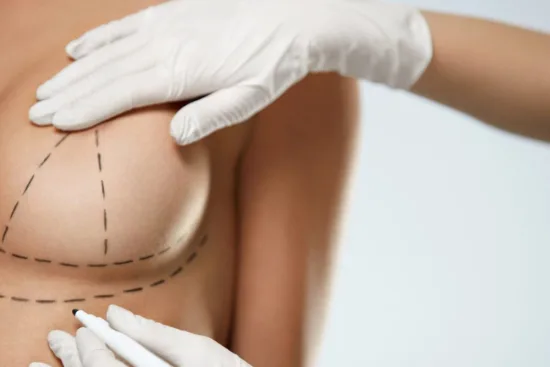
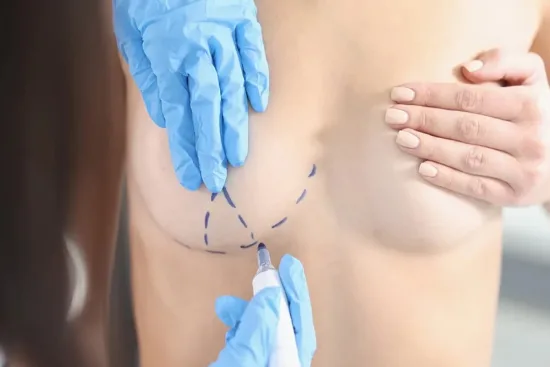
For the treatment of tuberous breasts, introducing a prosthesis alone is not sufficient. The surgery must also address the underlying glandular architecture. Inside, the gland is reshaped to allow its expansion both vertically and horizontally. When areolar enlargement is present, the areola is reduced through a periareolar incision, leaving a single scar around it.
In a single operation, the gland changes shape: the patient will have smaller breasts initially, but of a normal, rounded form. Following this first correction, the surgeon can insert a prosthesis to complete the shape correction and adjust breast volume according to the patient's wishes.
- Duration: less than two hours
- Anaesthesia: general
- Hospital stay: minimum 24 hours in the clinic
Tuberous breast correction prices: Turkey vs. the world
The cost of tuberous breast correction in Turkey ranges from approximately €2,500 to €5,500 all-inclusive, compared to €5,000 to €15,000 in the United States and €4,000 to €7,000 in the United Kingdom, a saving of 50 to 70% without a reduction in surgical standard at accredited facilities.
| Location | Price range | Details |
|---|---|---|
| Turkey (Istanbul) | €2,500 – €5,500 | All-inclusive package: surgeon, anaesthesia, implants, hospital, transfers, hotel. Save 50 to 70%. |
| United Kingdom | £4,000 – £7,000 | Surgery-only; NHS coverage extremely rare. |
| United States | $5,000 – $15,000 | Wide variance by surgeon seniority and state. |
| France / Western Europe | €4,500 – €8,000 | Social security reimbursement possible in rare cases. |
Price differences reflect lower operating overheads, favourable exchange rates, and competitive market conditions in Turkey, not reduced safety standards. Many Istanbul clinics hold JCI (Joint Commission International) accreditation. Patients should confirm whether their specific hospital, not merely the clinic group, is currently accredited before proceeding.
What is typically included in a Turkish all-inclusive package?
- Surgeon and anaesthesiologist fees
- CE/FDA-marked breast implants (where applicable)
- Hospital stay (1 to 2 nights minimum)
- Preoperative laboratory tests
- Compression garment
- Airport transfers and hotel accommodation
- Post-operative follow-up (typically 1 to 2 in-person checks before departure)
Surgery-only quotes require separate budgeting for accommodation (approximately €300 to €600 for 7 nights) and transfers (€80 to €120). Always obtain a written quote detailing exactly what is and is not included before confirming.
Postoperative recovery
Following tuberous breast correction, recovery follows a structured timeline that patients should plan around before travelling:
- First days: A bandage is applied immediately after surgery and removed after a few days. An elastic compression bra must be worn day and night for several weeks until swelling and bruising have fully resolved.
- Week 1: Arm movements should be limited. Superficial stitches are removed after 7 days; internal sutures are reabsorbed over 2 to 4 weeks.
- Weeks 2 to 4: Light physical activity (gentle stretching only, with a sports bra) may resume after 2 weeks. Lifting weights or making excessive physical effort should be avoided for 3 to 4 weeks.
- Sun exposure: The treated area must not be exposed to direct sunlight for 2 to 3 months to avoid scar darkening. Surgery during cooler months is generally advisable.
- Final result: Although improvements are visible immediately, the breasts initially appear firm and sit higher than their final position. As swelling subsides, they gradually settle into a softer, more natural shape. The definitive aesthetic result is typically visible after 6 months.
It is advisable to plan the intervention around family and professional commitments, allowing for at least 5 to 7 days in Istanbul before returning home.
Risks and complications
Tuberous breast correction is more technically demanding than standard breast augmentation. Patients should be explicitly counselled on the following risks before surgery:
- Double inframammary fold ("double bubble"): a known complication when the constricted ring is not adequately released prior to implant placement
- Implant-related complications: capsular contracture, malposition, rupture, or the need for implant replacement over time
- Asymmetry persistence or recurrence, particularly in severe Type III cases
- Areolar scar hypertrophy or widening around the periareolar incision
- Changes in nipple sensitivity: temporary in most cases, but potentially permanent in a minority of patients. Normalization typically occurs within 2 months; in some cases it may take up to a year.
- Haematoma, seroma, infection (general surgical risks)
- Need for secondary revision surgery: higher than after standard augmentation, especially when glanduloplasty was not performed
A long-term cohort study published in 2024 (Surcel et al.) on 156 patients confirmed that autologous fat grafting was associated with significantly fewer reoperations compared to implant-only correction, though it frequently required sequential sessions to achieve the desired volume.
Frequently asked questions
Is tuberous breast correction a one-stage or multi-stage procedure?
This depends on the severity of the deformity. Type I and most Type II cases can generally be corrected in a single operation combining implant placement, glandular scoring, and areola reduction. Type III deformities often require a staged approach: tissue expansion in the first stage, followed by definitive implant placement. Your surgeon will determine the appropriate protocol during the preoperative consultation.
Can tuberous breast surgery be combined with other procedures?
Yes. Tuberous breast correction is frequently paired with fat grafting for contour refinement. In some cases, a mastopexy (breast lift) is performed simultaneously. Combining procedures can reduce overall cost and recovery time, but increases anaesthesia duration and complexity. Your surgeon should assess suitability on an individual basis.
How long is the recovery after tuberous breast correction in Turkey?
Most patients remain in Istanbul for 5 to 7 days post-operatively for initial follow-up. Routine activities are typically resumed after 2 to 3 weeks; physical exercise and heavy lifting should be avoided for 6 weeks. Swelling and the final aesthetic result continue to evolve over 3 to 6 months.
Will insurance cover the procedure?
Coverage is rare. In France and the UK, social security or NHS reimbursement is occasionally possible for severe functional cases with significant psychological impact, but this is the exception rather than the rule. Most patients self-fund. It is advisable to request a medical certificate from a local specialist documenting the diagnosis and functional impact, which can support a reimbursement application.
How do I choose a surgeon in Turkey for this procedure?
Tuberous breast correction is technically demanding and should be performed by a board-certified plastic surgeon with documented experience specifically in this deformity. Request before-and-after photographs of tuberous cases specifically, verify membership in the Turkish Society of Plastic, Reconstructive and Aesthetic Surgery (TSPRAS), and confirm the operating facility's accreditation status (JCI or equivalent). A thorough virtual consultation before travel is strongly recommended.

"Medical journalist specializing in science communication, I put my expertise at the service of clear and accessible information. For Turquie Santé, I create content based on up-to-date medical data, in collaboration with specialists from partner clinics. My commitment is to provide reliable, transparent information that complies with international medical standards."
Need a personalized medical opinion?
Our partner doctors reply online within 24h, free of charge.