




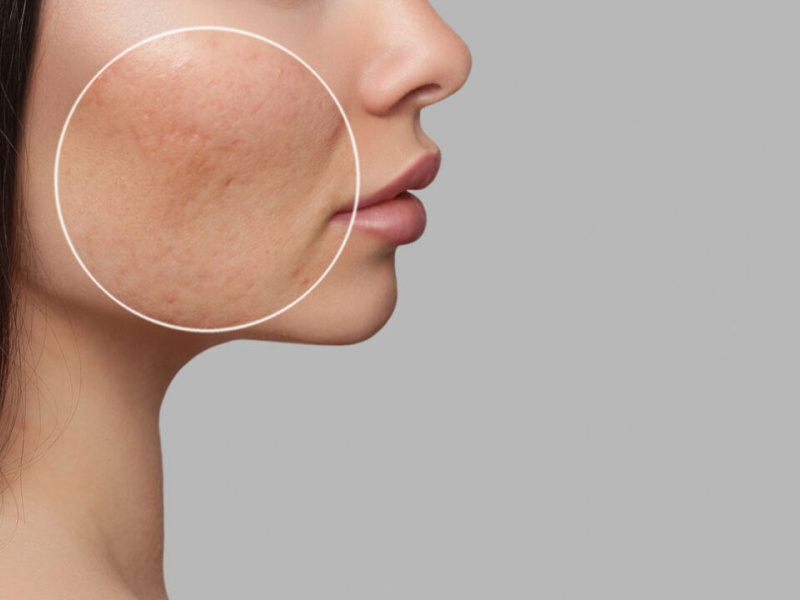


Enlarged pores are a common skin concern, particularly on the nose, cheeks, and forehead. They can become more noticeable with age, excess sebum production, and changes in skin elasticity. Although pores cannot be eliminated or permanently closed, their appearance can be reduced with an appropriate skincare routine and, in some cases, professional treatments.
Understanding the factors that contribute to enlarged pores is essential to choosing the right approach. This guide explores their main causes, the skincare ingredients supported by scientific evidence, and the professional treatments available, including their benefits, limitations, and expected results.
What are dilated pores?
Pores are the visible openings of hair follicles, each connected to a sebaceous (oil) gland. Their job is to release sebum, which keeps the skin supple and protected. A skin without pores could not regulate itself.
A pore looks "dilated" when its opening appears wider than normal. This happens when the follicle is stretched by trapped sebum and dead skin cells, when the surrounding skin loses firmness, or when the follicle itself is larger. A review in Dermatologic Surgery identifies exactly these three mechanisms as the major clinical causes: high sebum excretion, decreased elasticity around the pore, and increased hair follicle volume.
Two myths are worth correcting:
- Steam does not open pores, and cold water does not close them. Steam only softens sebum and surface debris, which makes cleansing easier for a short time.
- Pore size is not a health problem. It is a cosmetic concern, but it deserves a proper diagnosis because the best treatment depends on the cause.
Why do pores become dilated? The main causes
Understanding the root causes of enlarged pores is essential to choosing the right treatment approach.
Excess sebum production
Excess sebum production is one of the main factors contributing to visible pore enlargement, particularly in people with oily or combination skin. When excess oil accumulates inside the pores, it can make them appear larger. This is why enlarged pores are most common in the T-zone, including the forehead, nose, and chin, where sebaceous glands are more concentrated.
Loss of collagen and elastin with age
As collagen and elastin fibers weaken, the skin around each pore loses its supporting framework and the opening appears wider and more oval. This explains why enlarged pores are common not only in young oily skin but also in mature skin with laxity, even when oil production has decreased.
Sun damage
Chronic UV exposure degrades collagen and elastin and thickens the outer skin layer. Sun exposure can also increase sebum secretion. Daily sunscreen is therefore a genuine pore-care strategy, not only an anti-aging habit.
Blocked follicles
Dead cells, pollution particles, makeup residue and oxidized sebum accumulate inside the follicle. The plug stretches the pore and darkens at the surface, which turns it into a blackhead and makes it look even larger.
Hormones
Puberty, the menstrual cycle, pregnancy and menopause all influence sebaceous gland activity. Androgens in particular stimulate both sebum production and follicle size.
Genetics and ethnicity
Pore size is partly hereditary. Some people have visible pores regardless of how carefully they care for their skin.
Lifestyle
Smoking, heavy alcohol consumption and chronic UV or pollution exposure accelerate skin aging and can worsen pore appearance. Diet is often blamed, but the evidence linking specific foods to pore size is weaker than for the factors above.Daily skincare: what the evidence supports
Daily skincare: what the evidence supports
For mild to moderate enlarged pores, a consistent skincare routine is an affordable first step. Topical products can make pores less visible, but they cannot permanently change their structure.
- Cleanse twice a day: Use a gentle, non-comedogenic gel or foaming cleanser to remove excess oil and impurities. Avoid harsh soaps and excessive cleansing, which can irritate the skin and damage its protective barrier.
- Use salicylic acid to unclog pores: Salicylic acid (BHA, 0.5% to 2%) helps remove excess sebum and dead skin cells from pores. It is particularly useful for blackheads and clogged pores.
- Apply niacinamide to regulate oil production: Niacinamide (vitamin B3, 2% to 5%) may help reduce excess sebum and improve the appearance of pores. Its effects vary depending on skin type and formulation.
- Consider retinoids to improve skin texture: Retinol, adapalene, and prescription tretinoin help renew skin cells and prevent clogged pores. Some also support collagen production and skin firmness. Start gradually, use sunscreen daily, and avoid retinoids during pregnancy.
- Try alpha hydroxy acids for smoother skin: Glycolic acid and lactic acid exfoliate the skin's surface, helping improve texture and make pores less noticeable over time.
- Moisturize even if your skin is oily: Choose a lightweight, non-comedogenic moisturizer to maintain the skin barrier and prevent dehydration.
- Apply sunscreen every morning: Use broad-spectrum sunscreen with SPF 30 or higher to protect collagen, maintain skin firmness, and help prevent pores from becoming more noticeable with age.
Medical and aesthetic treatments: how they work and what to expect
For more visible or persistent pore concerns, especially those linked to oily skin, post-acne texture changes, or skin laxity, professional treatments offer significantly more impactful and longer-lasting results than topical care alone.
| Treatment | How it works | Sessions needed | Downtime |
| Superficial Chemical peels (glycolic, salicylic, TCA) | Controlled exfoliation of the skin surface : decongests pores, smooths texture, stimulates collagen | 4–5 sessions, every 2–3 weeks | None, resume activities immediately |
| HydraFacial | Combines microdermabrasion, vacuum extraction of blackheads, LED light therapy and deep hydration in one session | 1 session (repeatable monthly) | None |
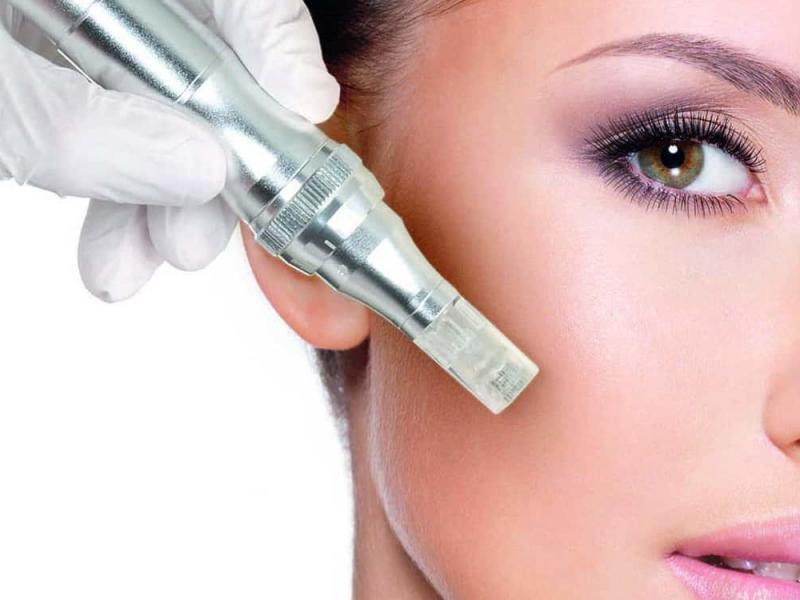
| Medical Microneedling | Creates micro-channels in the skin to trigger collagen and elastin production : improves firmness, pore size and post-acne texture | 3–6 sessions | 24–48 hours of redness |
| Fractional CO2 Laser | Precise controlled skin resurfacing with intensive collagen remodeling one of the most effective treatments for pore reduction | Usually 1 session | 5–7 days |
| Picoway Resolve Laser | Ultra-short picosecond pulses remodel deeper skin layers with minimal surface disruption, effective for pore refinement and pigmentation | 3–4 sessions | Minimal |
| Mesotherapy | Intradermal injections of hyaluronic acid, vitamins and skin-regulating actives, improves hydration, collagen production and skin texture | 4–6 sessions | None |
Which treatment suits your skin?
| Skin concern | Recommended options | Main benefit |
|
Oily skin, blackheads, congested pores |
Salicylic acid, niacinamide, superficial peels, HydraFacial |
Reduces sebum and clears follicles |
|
Pores plus fine lines and laxity |
Retinoids, microneedling, fractional CO2 or Picoway |
Rebuilds collagen around pores |
|
Pores plus acne scars or rough texture |
Fractional CO2 laser, microneedling, combined protocols |
Resurfaces and remodels |
|
Dull, dehydrated skin |
Mesotherapy, HydraFacial |
Hydration and texture |
|
Severe oiliness resistant to topicals |
Dermatological assessment for prescription options |
Targets the primary cause |
When to see a dermatologist
Book a consultation if:
- a single, unusually large pore persists on the face or back. This may be a dilated pore of Winer, a benign follicular lesion that needs specific management;
- your pores come with persistent acne, cystic breakouts or scarring;
- you see no improvement after 8 to 12 weeks of consistent skincare;
- you are unsure which treatment fits your skin type, or you have darker skin and want a laser.
Advanced treatments with Turquie Santé
Turkey offers a range of dermatological and aesthetic treatments to help reduce the appearance of enlarged pores and improve skin texture. The most suitable option depends on your skin type, the underlying cause of enlarged pores, and your treatment goals.
Through its partner clinics in Istanbul, Turquie Santé helps patients connect with qualified specialists who can assess their skin and recommend an appropriate treatment. Available options may include superficial or medium-depth chemical peels, medical microneedling, fractional CO₂ laser, PicoWay Resolve laser, HydraFacial, and mesotherapy.
Treatment recommendations are personalized following a medical assessment. Before choosing a clinic, it is important to verify the qualifications of the treating practitioner, the suitability of the technology for your skin, and the clinic's current accreditation status.

"Medical journalist specializing in science communication, I put my expertise at the service of clear and accessible information. For Turquie Santé, I create content based on up-to-date medical data, in collaboration with specialists from partner clinics. My commitment is to provide reliable, transparent information that complies with international medical standards."
Need a personalized medical opinion?
Our partner doctors reply online within 24h, free of charge.


"Main Specialty : Plastic, Reconstructive and Aesthetic SurgeryYears of Experience : 11 years.Notable Training : Osmangazi University Faculty of Medicine (1995-2003); Plastic, Reconstructive and Aesthetic Surgery specialization, Celal Bayar University (2009-2015); Basic Microsurgery Course, Hacettepe University Reconstructive Microsurgery AssociationProfessional Experience : Kartal Dr. Lütfi Kırdar Training and Research Hospital (2015-2021); Bahçeşehir University Faculty of Medicine Medical Park Göztepe Hospital (2021); Lokman Hekim Istanbul Hospital (2022-present)Memberships : Turkish Plastic, Reconstructive and Aesthetic Surgery Association; Aesthetic Plastic Surgery Association; Wound Care Association; ACELEMDER – Emergency Hand Surgery and Microsurgery AssociationLanguages Spoken : Turkish"
Sources & references
- Roh M. et al. Sebum output as a factor contributing to the size of facial pores. British Journal of Dermatology. 2006;155(5):890–894.
- Facial Pores: Definition, Causes, and Treatment Options. Dermatologic Surgery. 2016;42(3):277–285.
- The efficacy and adverse effects of treatment options for facial pores: A review article. Journal of Cosmetic Dermatology. 2023;22(3):763–775.
- Enlarged Facial Pores: An Update on Treatments. Cutis.
- Draelos Z.D., Matsubara A., Smiles K. The effect of 2% niacinamide on facial sebum production. Journal of Cosmetic and Laser Therapy. 2006;8(2):96–101.
- Shahin M. et al. Efficacy of fractional CO₂ laser in the treatment of enlarged pores. Zagazig University Medical Journal. 2023;29(1.1):87–92.
- Sampattavanich N. et al. A prospective, split-face, randomized study comparing fractional carbon dioxide laser with and without botulinum toxin type A in the treatment of enlarged pores. Abstract presented at the 43rd Annual Conference of ASLMS.
- Salem et al. Microbotox injection versus its topical application following microneedling in the treatment of wide facial pores: a split-face study. Journal of Cosmetic Dermatology. 2023;22:1249–1255.
- ClinicalTrials.gov. Fractional carbon dioxide laser versus microbotox injection in the treatment of wide facial pores. NCT05923996.

Among our clinics