



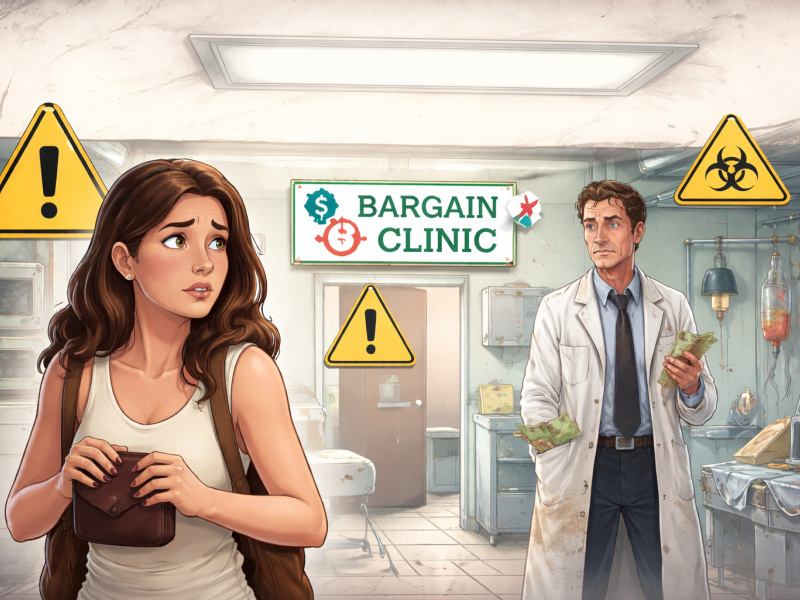



You've probably seen these ads: “Dental implants 70% cheaper,” “Cosmetic surgery for the price of a trip.” These offers seem irresistible. However, in medicine, there's always a reason behind every dollar saved.
At Turquie Santé, our Istanbul-based team has been assisting English-speaking patients for over 8 years. We have witnessed remarkable successes, but also situations where the pursuit of savings has led to dangerous compromises in the quality and safety of care.
This guide goes beyond general warnings. It presents the specific criteria used by our local experts to evaluate a clinic or surgeon.
Because medical excellence is a reality, but never in offers that are too good to be true.
When savings rhyme with risk: 3 common low-cost pitfalls
Our hands-on experience has allowed us to identify a recurring pattern among patients faced with ultra low-cost offers. Initial savings often turn into complications requiring corrective procedures, with a final total cost that is far higher without even factoring in the impact on health and morale.
The most 3 common compromises in the low-cost segment include:
- Inferior-quality materials: Use of implants or prostheses that are not CE-certified, raising concerns about durability and biocompatibility.
- Rushed protocols: Shortened operating times, rapid operating-room turnover, and minimal, or even nonexistent, post-operative follow-up once you return home.
- Ambiguous qualifications: Behind the title “surgeon,” there may sometimes be a general practitioner with brief training rather than an experienced specialist in the procedure performed.
In the majority of revision requests we handle, patients had initially chosen the cheapest option, drawn in by poorly detailed quotes and overly enticing promises.
Gray areas in Turkish medical regulations
Turkey has a solid medical regulatory framework. However, for international patients, understanding how it actually works is essential to avoid confusion and potential pitfalls.
Not all certifications carry the same weight, and more importantly, they do not always cover every medical procedure offered by a clinic.
What the main certifications really mean
Understanding medical certifications is essential for any patient seeking care abroad. Not all certifications guarantee the same level of quality or cover every procedure.
JCI (Joint Commission International)
JCI is an internationally recognized standard of excellence.
At Turquie Santé, we never stop at its mere presence. We systematically verify that the certification specifically applies to the service used, for example:
- The surgical operating room, not just the hospital as a whole.
- The relevant department involved in your procedure.
ISO standards and local certifications
These certifications confirm compliance with quality management processes.
They are important but not sufficient on their own:
- They focus on procedures, not medical expertise.
- They do not guarantee specialization for complex treatments.
That’s why we always combine them with on-site audits and field verification.
Ministry of Health Authorization
This authorization confirms that the clinic is legally allowed to operate.
However:
- It is mandatory, not selective.
- It does not always ensure a high level of specialization for every medical act.
The trap to avoid
A clinic may prominently display a JCI logo in its lobby, while the accreditation only applies to: its laboratory services or a limited, non-surgical unit not to the operating room where your procedure will take place.
Turquie Santé approach: Going beyond the label
Our verification process always goes further:
- Consultation of the official online registries.
- Validation of certificate numbers.
- Precise confirmation of the exact scope covered by each certification.
Because in healthcare, details make the difference between reassurance and real safety.
The “Turquie Santé Algorithm”: How we identify high-risk offers before you do
At Turquie Santé, we rely on a structured evaluation framework to filter out high-risk medical offers before they are ever presented to you.
These criteria are not based on hidden or inaccessible expertise. Any patient can apply them as long as they know what to check.
1. Certification, at the right level
We verify that accreditations (JCI, ISO, local authorizations) apply to the actual service being used, not just the institution as a whole, including:
- The operating room.
- The care unit.
- The specific medical specialty involved.
The question you should ask: “Can you show me the JCI certificate specifically covering the cosmetic/dental surgery department, including its validity number?”
2. True medical team specialization
A physician may be licensed without being a true expert in a specific procedure. We analyze:
- The annual volume of procedures performed (e.g., 200 rhinoplasties per year—not just “surgeries”).
- Ongoing training in the latest techniques.
- Proven, procedure-specific experience matching your request.
The question you should ask: “How many procedures identical to mine have you performed in the past 12 months? Can I see real result examples?”
3. Transparency of the care pathway (predictable = safer)
A reliable medical journey is one that is clear and free of gray areas. We assess:
- The depth of the pre-operative consultation.
- Whether required tests are clearly listed.
- How potential complications are managed (is there a protocol?).
- Post-treatment follow-up, including after you return home.
The question you should ask: “What is the exact follow-up plan at 1, 3, 6, and 12 months? Who will be my point of contact once I leave Turkey?”
4. On-site safety and hygiene standards (beyond paperwork)
Documents are one thing—real-world conditions are another. Our audits focus on:
- Sterilization and infection-control protocols.
- Emergency medical response plans.
- Traceability of implants and medical devices.
- Availability of a dedicated anesthesia and critical care team, 24/7.
The question you should ask: “Can I see a virtual tour or recent photos of the operating room and patient care areas?”
5. Value-to-safety ratio (not price alone)
An unusually low price is never evaluated in isolation. We always weigh it against:
- The actual quality of facilities and equipment.
- Human resources involved (staff-to-patient ratio).
- The scope of guarantees in case of complications or unsatisfactory results.
The question you should ask: “Is this price truly all-inclusive and contractually fixed? What happens medically and financially if a revision is needed?”
7 concrete checks to make yourself before signing
Even when working with a reputable organization, the patient remains an active decision-maker. Before approving a quote or booking a medical trip, these checks should be clearly documented—in black and white.
- Locked “All-Inclusive” quote: A reliable quote itemizes every cost: surgeon and anesthesiologist fees, implantable materials, hospitalization, medications, post-operative care, and follow-up. Anything not written down can later become an extra charge.
- Numbered certifications: Request the certificate numbers for JCI, ISO, or other accreditations, and verify their validity online.
- Dedicated, english-speaking patient coordinator: Test their responsiveness and medical knowledge before your arrival not after.
- Revision and guarantee agreement: This document must clearly state the duration, scope of coverage, and conditions of application, in a language you fully understand.
- Professional liability insurance (surgeon and clinic): Often overlooked but essential. Ask for a valid insurance certificate it is your legal protection in the event of medical negligence.
- Medical-ready hotel partner: For major procedures, post-operative accommodation must be arranged in a suitable facility with trained medical staff.
- Clear plan B: What happens if an unexpected complication requires extended hospitalization, a revision procedure, or medical repatriation?
The smart alternative: How Turquie Santé ensures quality and fair pricing
At Turquie Santé, our goal is not to offer the largest number of options, but the right options for the right indications, at the right level of safety.
This positioning allows us to avoid the pitfalls of low-cost medicine without drifting into unjustified pricing.
Our verified partnership model
Every partnership is built through a rigorous selection process, applied consistently across all healthcare providers in our network:
- Regulatory and documentation audit: Verification of legal authorizations, professional liability insurance, certifications, and compliance with Ministry of Health requirements.
- Technical audit and on-site inspection: Assessment of medical equipment, operating rooms, hygiene and sterilization protocols, and emergency management procedures.
- Medical team evaluation: Review of the surgeon’s background, true specialization, procedure volume, and the availability of a dedicated, English-speaking coordination team.
- Outcomes and long-term follow-up review: Anonymized analysis of patient records, consistency of results, quality of post-operative follow-up, and management of potential complications.
What this means in practice for the patient
This model allows us to guide you not simply to “a clinic in Turkey,” but to the specialist best suited to your specific medical situation, within a controlled and transparent network.
The price offered is neither artificially inflated nor dangerously reduced. It reflects a carefully balanced equation between medical expertise, safety standards, personalized support, and durable, long-term results.

"Professional medical writer, I provide information about medical procedures and treatments according to rigorous standards. Each content is based on reliable scientific references and a professional review process, to guide patients and help them make informed decisions with confidence."
Need a personalized medical opinion?
Our partner doctors reply online within 24h, free of charge.