




Summary
- Can a diabetic patient get dental implants?
- Why does diabetes increase certain risks?
- What HbA1c level is required for implant placement?
- What is the success rate of dental implants in diabetic patients?
- When is a dental implant discouraged or postponed?
- What assessment is needed before an implant for a diabetic patient?
- How is the placement performed and how to reduce risks?
- What are the alternatives if an implant is not feasible?
- Long-term follow-up: The decisive factor
- How much does a dental implant cost in Turkey?
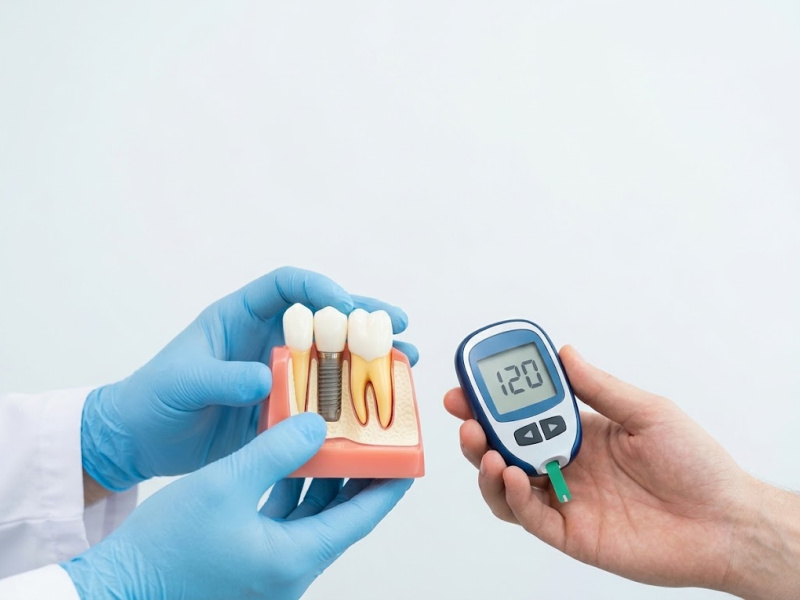
Is it possible to have dental implants placed when you have diabetes? The answer is yes, under certain specific conditions. While poorly controlled diabetes can delay healing and increase the risk of infection, well-managed diabetes today allows for success rates very close to those of non-diabetic patients.
Glycemic control, evaluated notably through glycated hemoglobin (HbA1c), is a critical factor in your pre-operative assessment. What levels require particular vigilance? What medical tests should be performed before surgery, and what precautions ensure long-term treatment success? This guide reviews the latest scientific guidelines and essential clinical prerequisites.
You will also discover how Turquie Santé evaluates your medical records remotely to help you plan safe, high-quality dental care in Turkey.
Can a diabetic patient get dental implants?
Yes, in the vast majority of cases, provided that diabetes is sufficiently controlled and monitored.
Today, diabetes is considered a relative risk factor, not an absolute contraindication. Recent systematic reviews confirm that dental implant placement in patients with well-controlled blood sugar achieves success rates very close to those of non-diabetic patients. Conversely, poor glycemic control significantly increases the risk of post-operative complications and implant failure.
The final clinical decision is always made on a case-by-case basis. Before proceeding, your dental surgeon and the Turquie Santé team will evaluate key clinical factors, including:
- Glycemic control (HbA1c level).
- The type of diabetes (data primarily concerns type 2 diabetes; type 1 diabetes requires even more personalized evaluation).
- Any associated complications (kidney, cardiovascular, microcirculatory damage);
- Oral health (gum condition and bone volume);
- The opinion of your primary care physician or endocrinologist.
Why does diabetes increase certain risks?
Chronic hyperglycemia impairs the immune system and slows down cellular regeneration. In implantology, three key physiological mechanisms are directly affected: wound healing, immune defense against infection, and bone stability.
Delayed healing and increased infection risk
After implant surgery, two biological processes are critical for long-term success:
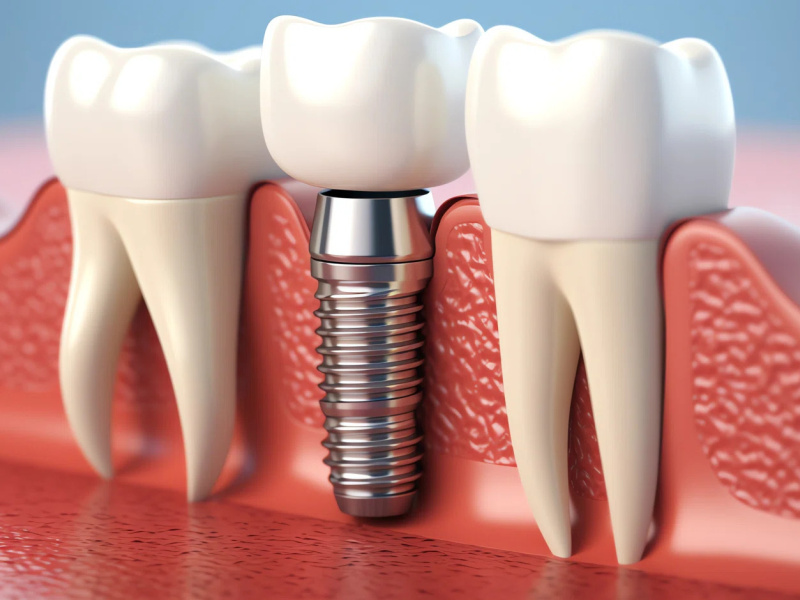
- Osseointegration: The titanium implant must fuse securely with the jawbone.
- Soft-tissue healing: The gum tissue must heal cleanly to form a tight, protective barrier around the implant.
In patients with poorly controlled blood sugar, blood microcirculation is impaired. As a result, tissue healing is delayed, and the risk of early bacterial infection at the surgical site increases.
Impact on bone and gum health
A landmark meta-analysis published in Acta Odontologica Scandinavica (pooling data from 10 clinical studies) highlights that diabetic patients generally experience:
- Slightly higher marginal bone loss around the implant over time;
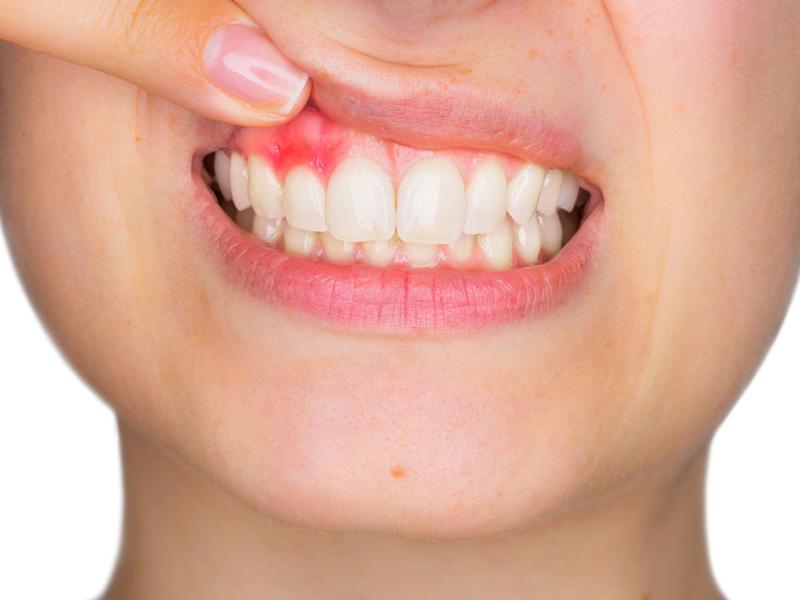
- Deeper periodontal pockets and an increased tendency for gums to bleed.
The research confirms a direct correlation: the higher the HbA1c level, the greater the risk of peri-implant tissue inflammation. However, the study concludes that dental implants remain a reliable and highly effective solution provided blood sugar levels are properly stabilized.
The crucial role of gum health (Periodontitis)
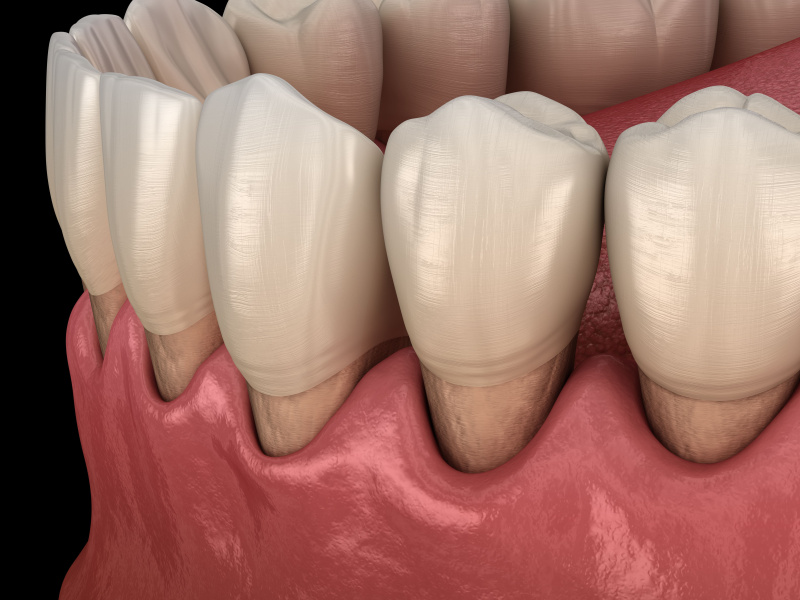
Diabetes and periodontal disease share a strong two-way relationship. Untreated periodontitis (gum disease) significantly elevates the risk of peri-implantitis—an inflammatory condition that can destroy the supporting bone around an implant. For this reason, comprehensive periodontal treatment must always precede any implant placement.
What HbA1c level is required for implant placement?
There is no single absolute threshold, but the scientific community agrees on specific benchmarks: an HbA1c level of ≤ 7% indicates well-controlled diabetes, while a level of > 8% signals imbalance requiring prior management.
Since HbA1c (glycated hemoglobin) reflects the average blood sugar level over the past three months, a recent measurement is mandatory before any procedure.
| HbA1c | What Reviews Show | Generally Considered Approach |
| ≤ 7 % | Results often comparable to non-diabetic patients | Implant placement considered after a complete pre-operative assessment. |
| Between 7 and 8 % | Intermediate zone, moderate risk depending on profile | Case-by-case evaluation, endocrinologist's opinion |
| > 8 % | More bone loss, bleeding, and inflammation around the implant | Stabilize first, then re-evaluate |
Implant survival rate in diabetic patients:
A scientific review with dose-response analysis provides very reassuring data: the implant survival rate remains high (from 92.6% to 100% over 3 years) in patients with an HbA1c below 8%.
However, the higher the HbA1c level, the more the clinical parameters around the implant (pocket depth, bleeding, bone level) deteriorate. This is why stabilizing blood sugar remains the key to a lasting result.
What is the success rate of dental implants in diabetic patients?
Excellent news: in patients with well-controlled diabetes, the survival rate of dental implants is generally above 90% to 95%, with results very close to those of non-diabetic individuals.
A study published in BMC Oral Health confirms that when the HbA1c level is ≤ 7%, the results and durability of implants are in all respects comparable to the general population.
These overall success rates are an encouraging average, but long-term success depends on several key factors:
- Glycemic control (daily HbA1c stability).
- Type and duration of diabetes (especially for type 2 diabetes).
- Oral hygiene and absence of gum disease (periodontitis).
- Smoking, which remains a major aggravating factor for healing.
- Age and the number of implants placed.
Do you have recent medical records and a plan for dental implants? The Turquie Santé team can submit your medical file and recent test results to its partner dentists for a secure preliminary evaluation.
Request a free and personalized medical opinion!
When is a dental implant discouraged or postponed?
Implants may be postponed or discouraged in certain situations:
- Poorly controlled diabetes, with high HbA1c or very unstable blood sugar levels.
- Frequent hypoglycemia or recently diagnosed and unstable diabetes.
- Active, untreated periodontitis.
- Ongoing dental or gum infection.
- Heavy smoking, which adds to the risk.
- Severe diabetes complications or other associated diseases, according to the endocrinologist's opinion.
- Insufficient oral hygiene or inability to adhere to long-term follow-up.
A postponement is not a definitive refusal. After improving glycemic control and treating gum issues, a new evaluation can be performed.
What assessment is needed before an implant for a diabetic patient?
The assessment generally includes:
- Recent HbA1c and, if necessary, a letter or opinion from your endocrinologist.
- Complete list of medications (insulin, antidiabetics, anticoagulants, bisphosphonates, etc.).
- Clinical dental and periodontal examination: gums, plaque, mobility, infections.
- Imaging: dental panoramic X-ray and, depending on the case, a 3D scan (CBCT) to assess bone volume and quality.
- Evaluation of other risk factors: smoking, hygiene, history of healing issues.
How is the placement performed and how to reduce risks?
The placement follows the usual steps: planning, local anesthesia, implant insertion, and then healing before the crown. For diabetic patients, the team may adapt the management: scheduling the appointment in relation to meals and treatment, monitoring blood sugar, reinforced hygiene instructions, choosing the timing of loading, and close monitoring of healing. The use of antibiotic or antiseptic treatment is decided by the practitioner, depending on the patient's profile.
Immediate loading (placing the temporary tooth quickly) is not suitable for all patients. In the subgroup analysis of the 2020 meta-analysis, the association with increased pocket depth was more pronounced with immediate loading; a more gradual protocol may therefore be considered depending on the profile.
What are the alternatives if an implant is not feasible?
Depending on the situation, the practitioner may suggest:
- A bridge on natural teeth, if the adjacent teeth are suitable;
- A removable prosthesis, partial or complete;
- Postponing the implant until diabetes is balanced and gums are treated;
- Implants with a delayed protocol, with a more cautious healing period.
None of these options is the best for everyone: they are chosen based on oral health status, diabetes, and your expectations.
Long-term follow-up: The decisive factor
The risk does not end with healing. A dental implant can become inflamed later (mucositis, peri-implantitis), and this risk is more pronounced when diabetes is poorly controlled. Reviews emphasize the need to assess HbA1c before placement and throughout the implant's lifespan, and the importance of multidisciplinary care.
In practice: rigorous brushing, interdental cleaning, regular check-ups with a dentist or periodontist, and maintaining good glycemic control.
How much does a dental implant cost in Turkey?
The price depends on the case: number of implants, type of prosthesis, need for bone grafting or prior treatments. We do not provide a general price range, as it would be misleading for a diabetic patient whose treatment plan may change after the assessment.
Factors influencing the cost:
- Number of implants and teeth to be replaced.
- Materials and type of prosthesis (crown, bridge, full prosthesis).
- Bone grafting or sinus lift if bone is insufficient.
- Prior treatments (scaling, gum treatment, extractions).
- 3D scan and complementary examinations.
- Length of stay and number of appointments.
To check in a quote: what is included (examinations, prosthesis, check-ups), potential additional costs (graft, unforeseen treatments), the clinic's warranty, and follow-up conditions. Turquie Santé provides a personalized estimate after analyzing your file.

"Medical journalist specializing in science communication, I put my expertise at the service of clear and accessible information. For Turquie Santé, I create content based on up-to-date medical data, in collaboration with specialists from partner clinics. My commitment is to provide reliable, transparent information that complies with international medical standards."
Need a personalized medical opinion?
Our partner doctors reply online within 24h, free of charge.